
Estate
Estate
The Georgian Inheritance
Georgia is internationally recognised as the birthplace of wine. In 2017, an international team led by the University of Pennsylvania Museum, working with the Georgian National Museum, published findings showing that pottery excavated at the Neolithic sites of Gadachrili Gora and Shulaveris Gora (south of Tbilisi) carried the chemical fingerprint of grape wine dating to between 6000 and 5800 BC. The Guinness World Records lists this as the oldest known wine in human history, surpassing the previous record from north-western Iran by roughly a thousand years.
The qvevri – the large, egg-shaped clay vessel buried in the earth to ferment and age wine – has been in continuous use across that same period. UNESCO inscribed the qvevri method on its Representative List of the Intangible Cultural Heritage of Humanity in 2013, recognising it as a living practice rather than a preserved one. And its influence now travels well beyond Georgia, shaping contemporary skin-contact white wine production by winemakers across Italy, Slovenia, Austria, France, and the United States.
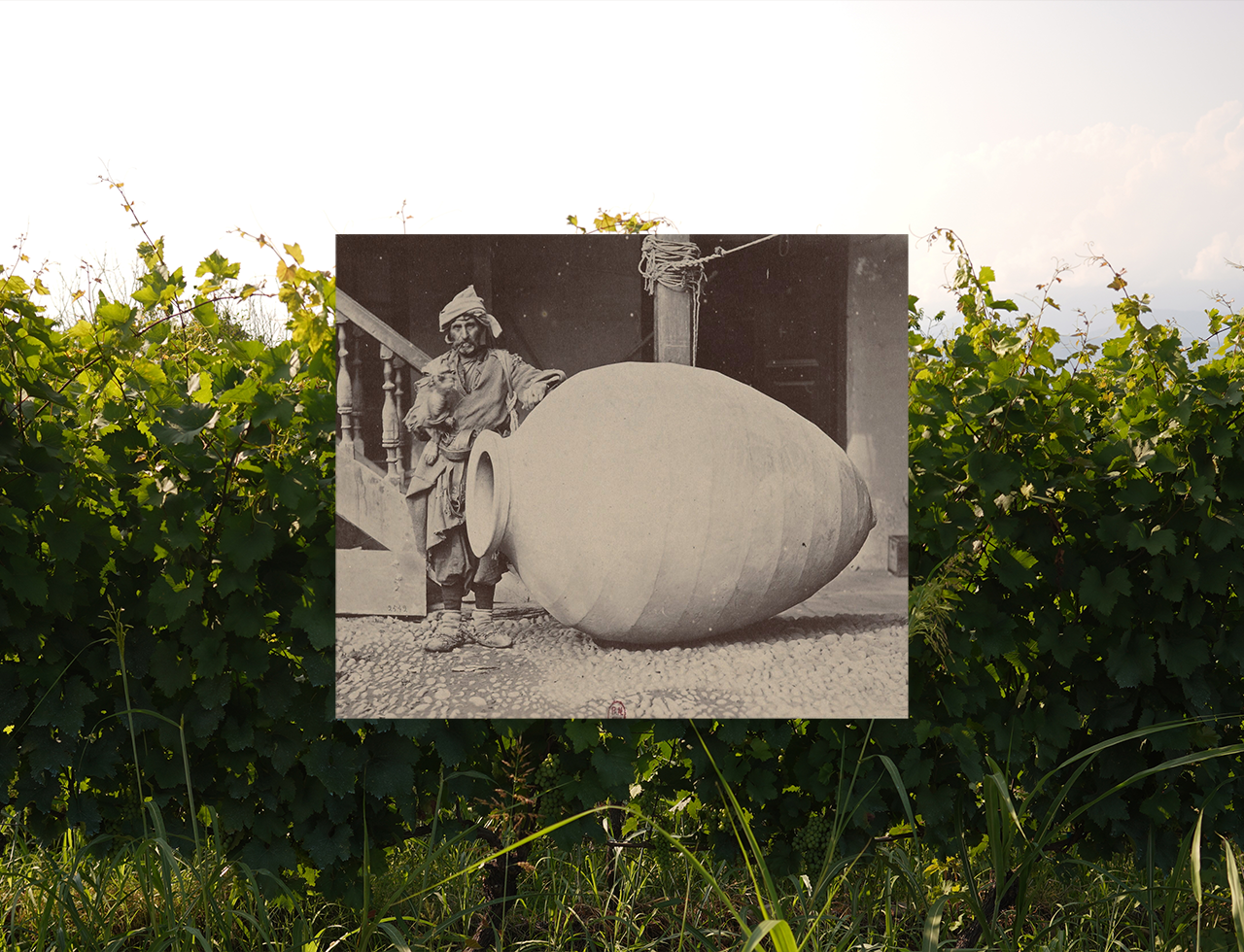
213
Georgia holds more than 500 indigenous grape varieties – roughly one-sixth of the world's total – preserved in part through a national grape collection at Jighaura, north of Tbilisi. Two of them do most of the country's work abroad: Rkatsiteli, the most widely planted white in Georgia and one of the leading grapes across the Caucasus and Eastern Europe; and Saperavi, one of the few teinturier grapes in the world – red flesh as well as red skin – producing wines of depth that age for decades, with complexity rivalling Nebbiolo. Both are Kakhetian by origin. Both find some of their finest expression in the valley our estate looks across.
Where We Stand
The qvevri is, in the end, a vessel – clay, egg-shaped, buried to its neck in the earth. It is not, on its own, what gives Georgian amber wine its character. Those qualities are produced by a method that surrounds the vessel: the condition of the grapes at picking, the timing of the crush, the proportion of skins and stems, the duration of contact, the moment of separation. The clay holds the wine. It does not make it.
Vine Era is built on that distinction. We have taken the full Kakhetian methodology and rebuilt it in modern equipment – steel cisterns, contemporary production lines, monitored temperature and
Where We Stand
The qvevri is, in the end, a vessel – clay, egg-shaped, buried to its neck in the earth. It is not, on its own, what gives Georgian amber wine its character. Those qualities are produced by a method that surrounds the vessel: the condition of the grapes at picking, the timing of the crush, the proportion of skins and stems, the duration of contact, the moment of separation. The clay holds the wine. It does not make it.
Vine Era is built on that distinction. We have taken the full Kakhetian methodology and rebuilt it in modern equipment – steel cisterns, contemporary production lines, monitored temperature and oxygen, controlled fermentation curves. A qvevri buried in the earth is at the mercy of its season; the method does not change, only the precision with which it is held.
To honour an eight-thousand-year-old technique is not to preserve its vessel. It is to perfect its method – a philosophy that we will always strive to uphold.